Trailer Lease vs. Loan Financing: Which Makes Sense for Your Business?
Buying a trailer is a major investment for any business, whether you are adding your first trailer or expanding an operation that is already bringing in steady work. The way you finance that trailer can be just as important as the trailer itself.
A traditional loan and an equipment lease can both help you get the equipment you need, but they work differently. The better option depends on how quickly you need the trailer, how you want to manage monthly payments, how much cash you want to keep in the business, and what you plan to do with the equipment long term.
For trailer businesses, those decisions can have a direct impact on how quickly you can take on new jobs and how much working capital you have available throughout the year.
Lease vs. Loan: What Should You Compare?
It is easy to compare financing options by looking only at the interest rate or monthly payment. But for a growing trailer business, there is more to consider.
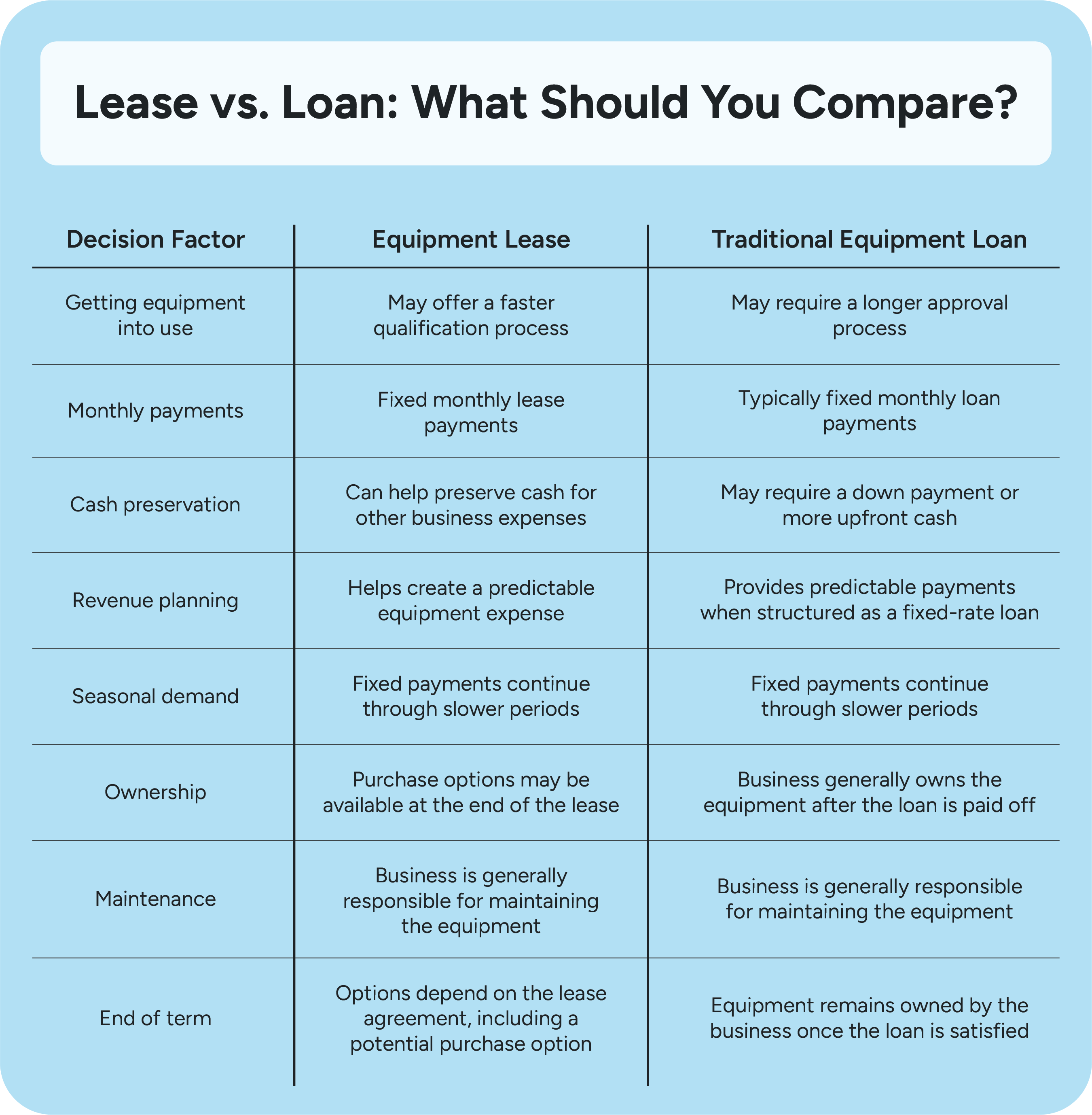
Purchase options may be available at the end of the lease
Neither option is automatically better. The right choice depends on what the equipment needs to do for the business and how the business wants to manage the expense.
How Quickly Do You Need the Trailer?
For a trailer business, time can have a real dollar value.
Imagine a second year trailer rental business that has built a steady customer base and starts receiving more requests than its current fleet can handle. The owner finds a trailer that would allow the business to take on several additional jobs each month.
The owner applies for traditional financing, but the process takes longer than expected. By the time the financing is finalized and the trailer is ready to put to work, some of those customers have already found another option.
The financing itself may have worked out fine. The problem was timing.
For a business that has work waiting, getting equipment into service sooner can be an important part of the financing decision.
Equipment leasing can be an alternative for businesses that want a financing process focused specifically on business equipment. Clicklease provides business-purpose equipment leasing with a fast qualification process, fixed lease terms, and fixed monthly payments.
What Could Happen When You Put a Trailer to Work Sooner?
Now consider a similar business that takes a different approach.
The owner has a second year trailer rental business with regular demand and sees an opportunity to add another trailer to the fleet. Instead of waiting through a longer traditional financing process, the owner chooses an equipment lease and gets the trailer into service sooner.
The additional trailer begins generating rental revenue while the business continues operating its existing fleet.
That does not mean leasing guarantees revenue or that every trailer will immediately pay for itself. Demand, utilization, pricing, maintenance, insurance, and other operating costs all affect profitability.
But when a business has customers waiting for equipment, the ability to put that equipment to work sooner can be an important consideration.
The question is not simply, "Which financing option costs less?"
It is also, "What could this trailer do for my business while I am paying for it?"
How Do Fixed Monthly Payments Help With Cash Flow?
Trailer businesses can have expenses that fluctuate throughout the year. Demand may increase during certain seasons and slow down during others.
That makes cash flow planning especially important.
With fixed monthly lease payments, a business knows what its equipment payment will be each month. That predictability can make it easier to plan around other expenses such as insurance, maintenance, storage, marketing, payroll, and unexpected repairs.
For example, if a trailer is expected to generate an average of $2,000 in monthly rental revenue, the owner can look at the trailer payment alongside the expected revenue and operating costs before deciding whether the additional equipment makes sense.
The goal is not to assume that revenue will always exceed the payment. It is to understand the full picture before adding another fixed business expense.
What About Seasonal Trailer Demand?
Seasonality can change the way a business looks at financing.
A trailer may generate significantly more revenue during certain months than others. But the financing payment generally does not change just because demand does.
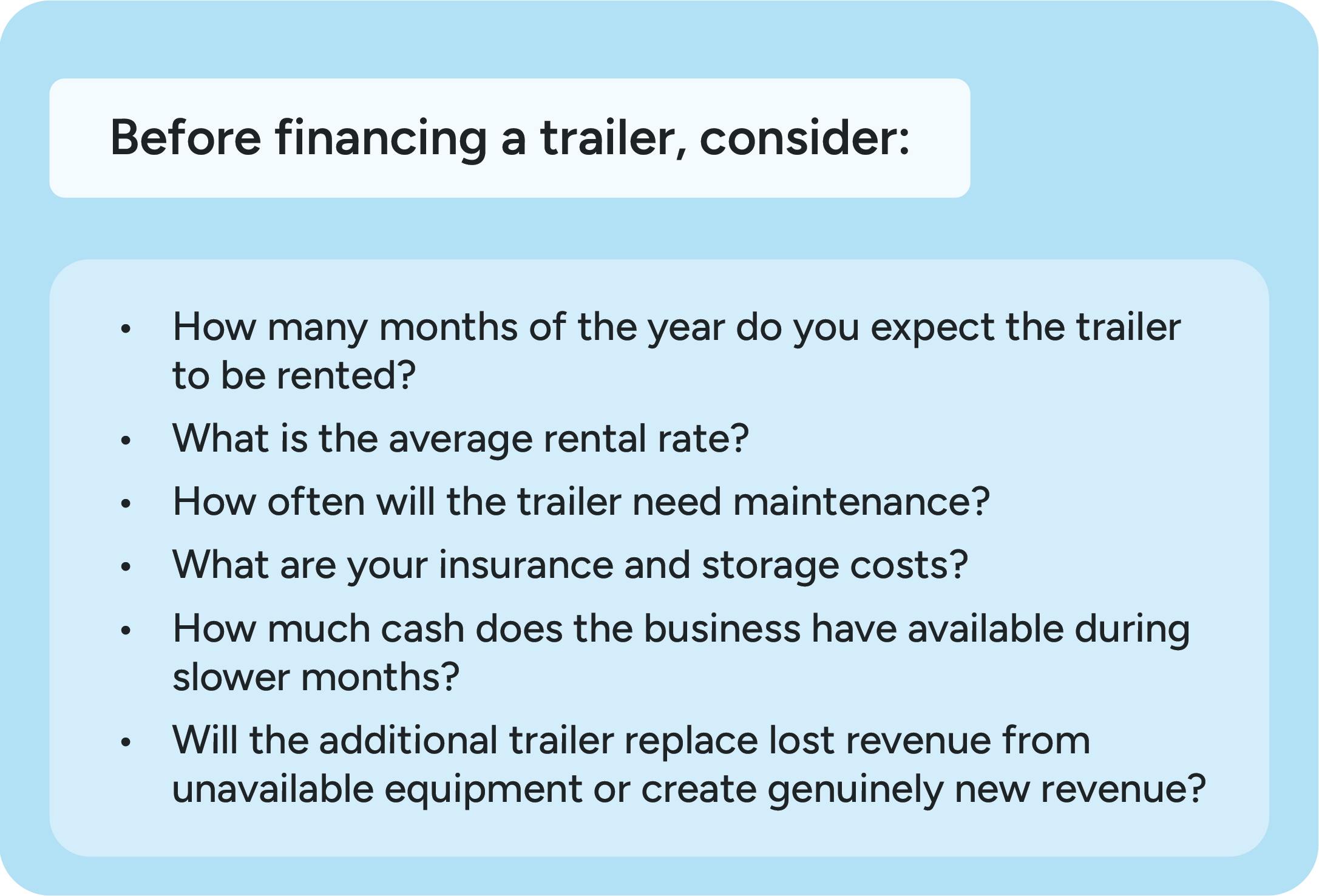
Before financing a trailer, consider:
- How many months of the year do you expect the trailer to be rented?
- What is the average rental rate?
- How often will the trailer need maintenance?
- What are your insurance and storage costs?
- How much cash does the business have available during slower months?
- Will the additional trailer replace lost revenue from unavailable equipment or create genuinely new revenue?
These questions can help determine whether adding equipment fits the business's current cash flow.
When Does an Equipment Lease Make Sense?
An equipment lease may make sense for a trailer business when the owner wants to preserve cash, needs equipment relatively quickly, or prefers predictable payments over the lease term.
It can be particularly worth considering when the trailer is expected to generate revenue soon after it is acquired.
For example, a business owner may already have customers requesting additional trailer capacity. If the owner has enough demand to support another trailer but does not want to tie up a large amount of available cash in the purchase, leasing may provide another way to add the equipment while keeping cash available for other business needs.
The numbers still need to work.
A lease payment is another monthly obligation, so owners should consider expected utilization, revenue, operating expenses, and slower periods before committing.
What Happens at the End of a Lease?
One difference between leasing and traditional financing is what happens when the financing term ends.
With a traditional equipment loan, the business generally owns the trailer once the loan has been paid in full.
With an equipment lease, the end-of-term options depend on the specific lease agreement. With Clicklease, there may be an option to purchase the equipment at the end of the lease, but the business is not obligated to purchase it.
That can give a business owner flexibility when deciding what to do with equipment that has reached the end of its lease term.
The owner can consider whether the trailer is still meeting the business's needs, whether it is generating enough revenue to justify keeping it, and whether purchasing it makes sense based on the terms of the agreement.
What Should You Ask Before Signing a Trailer Equipment Lease?
Before choosing any financing option, make sure you understand the full agreement and how the payment fits into your business plan.
Ask:
- What is the total amount I will pay over the full term?
- What is my fixed monthly payment?
- How long is the lease term?
- What are my options at the end of the lease?
- Is there a purchase option, and if so, what are the terms?
- What fees or additional costs should I expect?
- Who is responsible for maintenance and repairs?
- What happens if my business has a slower season?
- Does the payment fit comfortably within my expected cash flow?
- How quickly can I put the trailer into service?
A financing decision should make sense beyond the first few months. Look at the full term, the expected revenue from the equipment, and the effect the payment will have on the rest of the business.

The Right Financing Depends on the Business
A traditional equipment loan can be a good fit for a business that wants to finance a trailer with the goal of owning it outright after the loan is paid off. An equipment lease can be another option for a business that values speed, predictable payments, cash preservation, and flexibility at the end of the term.
For a trailer business in its second year, the decision may come down to a simple question: what does the business need the equipment to do right now?
If the priority is getting another trailer into service, keeping cash available for other expenses, and knowing what the monthly equipment payment will be, an equipment lease may be worth considering.
The best financing decision is the one that fits the trailer, the business's expected demand, and its ability to manage the payment over time.