Equipment Financing Trends by Industry
Equipment financing by industry shows that demand is not rising evenly. It is accelerating in very specific small business industries where equipment directly drives revenue. Right now, landscapers, cleaning businesses, food service operators, auto repair shops, and fitness studios are leading that surge.
What connects them is simple. These are businesses where better equipment immediately translates into more jobs completed, faster turnaround, or higher ticket services. Leasing is becoming the preferred way to access that equipment without slowing down cash flow.
This blog breaks down key equipment financing trends, what equipment is driving them, and how sellers can use these trends to guide smarter sales conversations.
What Is Driving Leasing Demand Right Now
The rise in equipment leasing is not happening in a vacuum. Several shifts are pushing small businesses toward leasing instead of paying up front.
First, equipment costs have increased across many categories, making large purchases harder to absorb in cash. At the same time, demand for services has stayed strong in industries tied to home services, maintenance, and local consumer needs.
There is also a speed factor. Businesses want to take on more work now, not later. Leasing allows them to upgrade or expand capacity without waiting to build up capital.
Looking at equipment financing by industry makes it easier to see which businesses are investing in equipment now and why those purchases matter.
Industries Seeing the Strongest Activity
While equipment financing is used broadly, a few industries are seeing especially strong momentum.
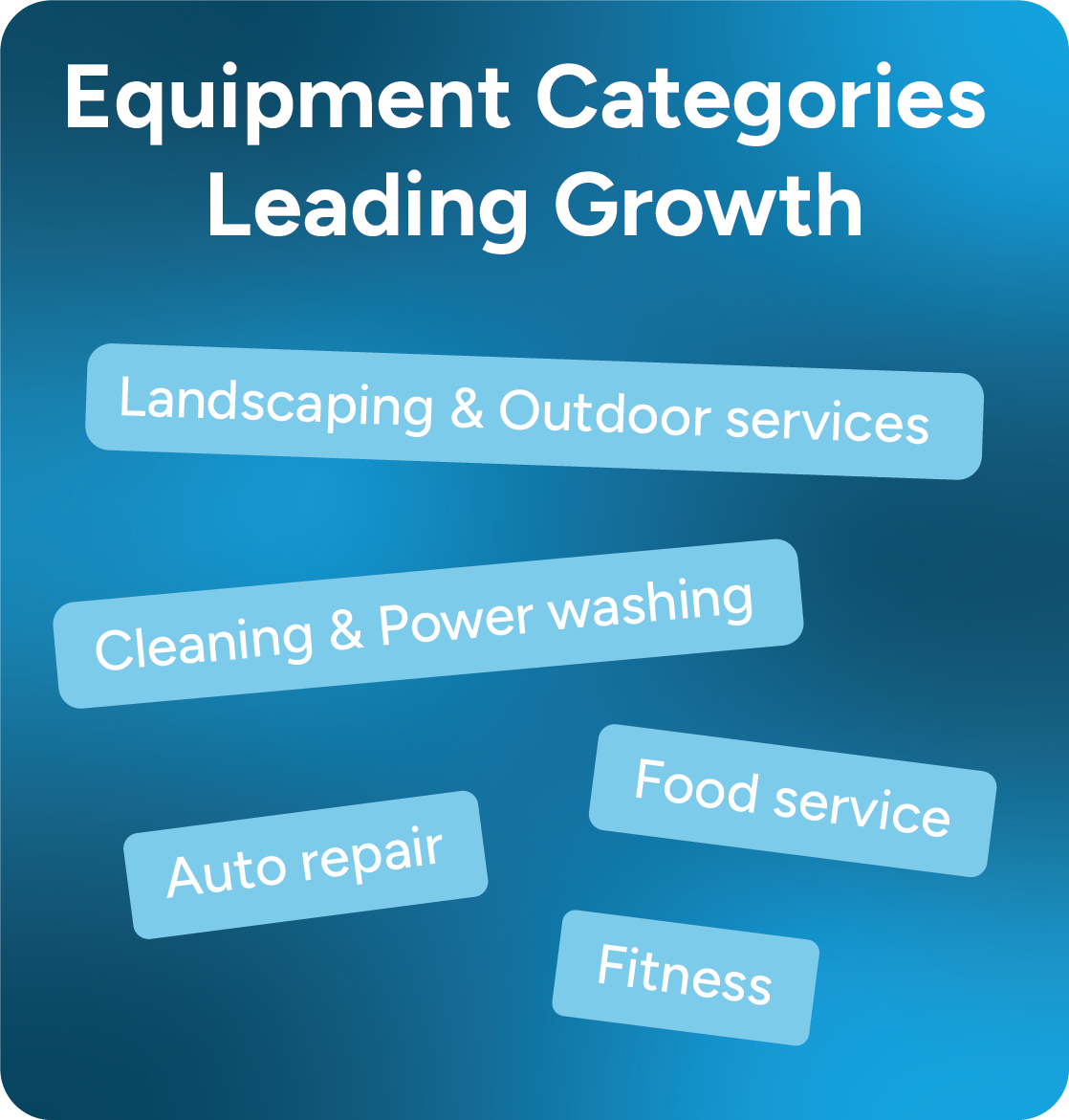
Landscaping and outdoor services continue to lead, driven by steady residential and commercial demand. Cleaning businesses, including power washing and janitorial services, are also expanding quickly as property maintenance becomes more consistent and recurring.
Food service remains active, particularly among smaller or independent operators upgrading kitchen equipment to improve speed and consistency. Auto repair shops are investing heavily in diagnostic and specialty tools as vehicles become more complex. Fitness businesses are another growing segment, especially boutique studios and independent gym owners upgrading to stay competitive.
These industries share a common pattern. Equipment is not optional. It is central to how revenue is generated.
Equipment Categories Leading Growth
Within the equipment financing industry, certain types are driving the majority of financing activity. These are typically tools that either increase capacity or unlock new services.
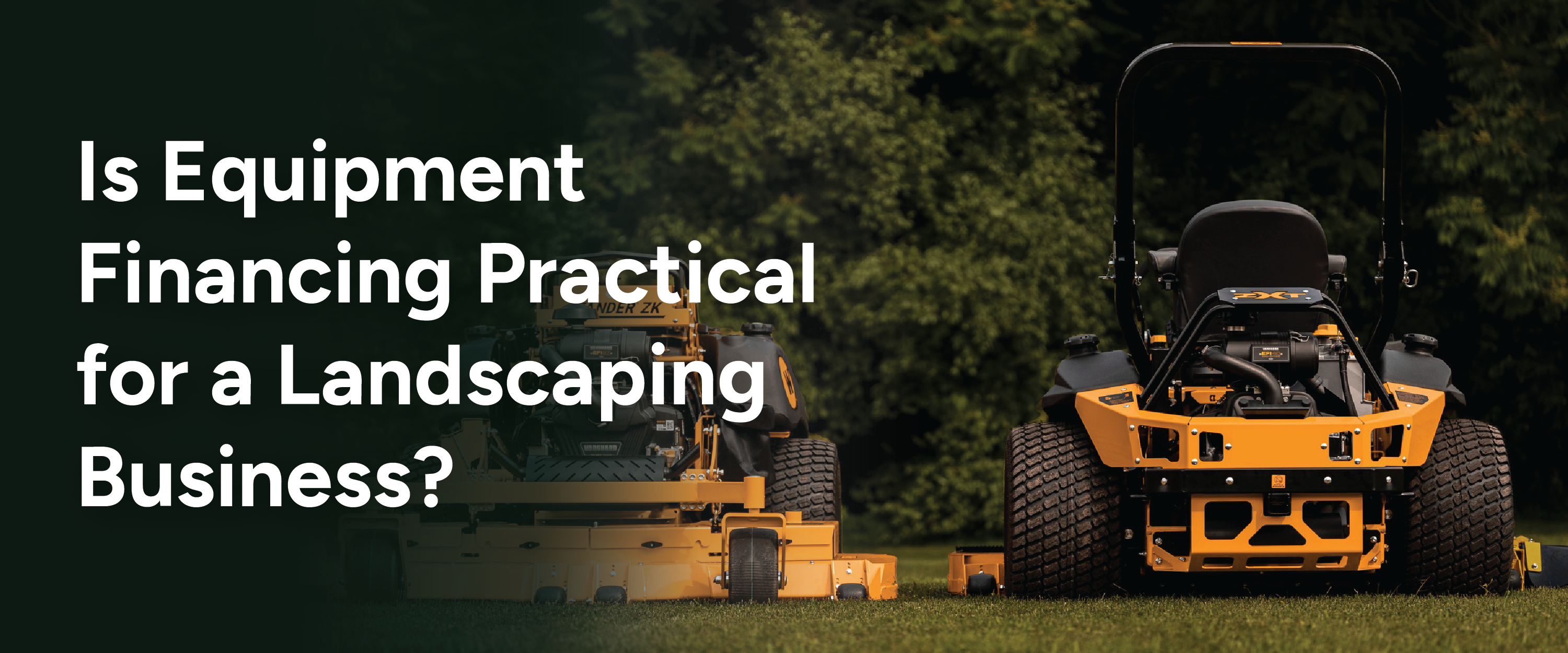
In landscaping and outdoor services, demand is growing for:
- Zero-turn mowers and stand-on mowers
- Compact loaders and mini skid steers
- Commercial-grade trimmers and blowers
- Irrigation and trenching equipment
These machines reduce labor time and allow crews to take on more jobs per day.
In cleaning and power washing:
- Commercial pressure washers with higher PSI output
- Soft wash systems for delicate surfaces
- Water reclamation and filtration systems
- Floor scrubbers for commercial spaces
Advancements in efficiency and environmental compliance are driving adoption here.
- High efficiency ovens and combi ovens
- Refrigeration systems with better energy performance
- Prep automation equipment
- Point of sale and kitchen display systems
Speed, consistency, and labor savings are the main drivers.
- Advanced diagnostic scanners
- Tire and alignment systems
- Vehicle lifts and specialty tools
- ADAS calibration equipment
Modern vehicles require more sophisticated tools, making upgrades essential rather than optional.
- Connected cardio equipment
- Strength training systems with digital tracking
- Recovery and wellness equipment
- Boutique studio-specific setups like reformers or cycling rigs
Member experience and retention are pushing these investments.
Why Small Businesses Are Choosing Leasing Now
For many small businesses, leasing is no longer a fallback option. It is becoming the default way to get equipment.
The main reasons are simplicity and access. Instead of tying up cash in a large purchase, businesses can spread costs over time and keep capital available for payroll, marketing, or expansion.
There is also a practical mindset shift happening. Customers are thinking less about owning equipment outright and more about how quickly that equipment can generate revenue.
Leasing supports that approach by:
- Lowering upfront cost barriers
- Aligning payments with revenue generation
- Allowing faster upgrades as technology improves
This is especially important in industries where equipment evolves quickly or where demand fluctuates seasonally.
How Demand Differs by Industry Needs
Even though leasing is growing across the board, the reasons behind that demand vary by industry.
Landscaping and cleaning businesses are often focused on speed and job volume. Their goal is to complete more work in less time, so equipment that increases efficiency is a priority.
Food service operators are more focused on consistency and labor savings. Equipment that reduces errors or speeds up preparation can have a direct impact on profitability.
Auto repair shops are driven by necessity. As vehicles become more complex, new tools are required just to stay operational and competitive.
Fitness businesses are more experience-driven. Equipment upgrades are tied to attracting and retaining members, which makes the decision more about differentiation than pure efficiency.
Understanding these differences helps sellers position financing in a way that aligns with what each customer actually values.
How Sellers Can Use This Trend Data
Trend data is only useful if it changes how you sell.
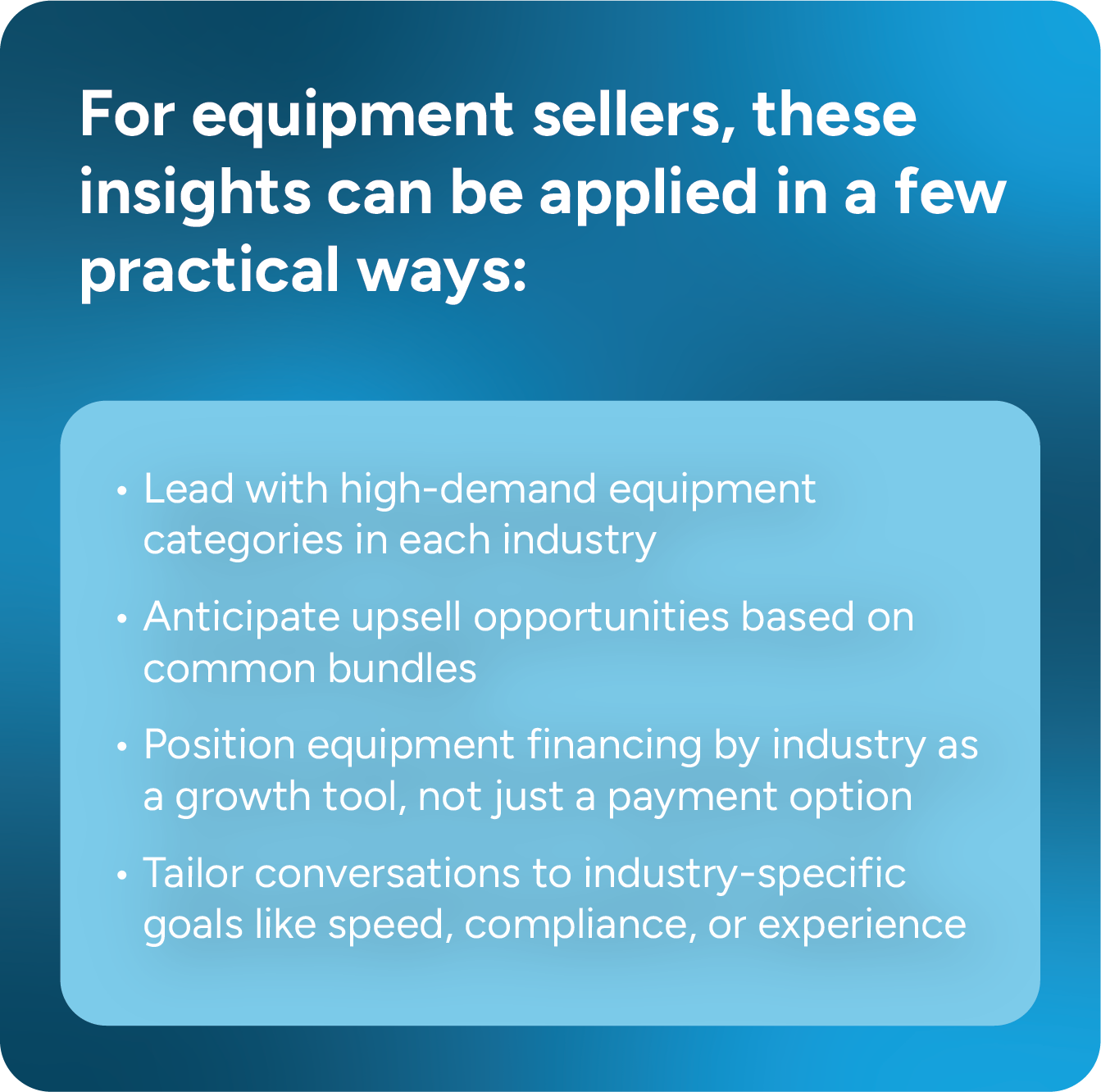
For equipment sellers, these insights can be applied in a few practical ways:
- Lead with high-demand equipment categories in each industry
- Anticipate upsell opportunities based on common bundles
- Position equipment financing by industry as a growth tool, not just a payment option
- Tailor conversations to industry-specific goals like speed, compliance, or experience
When sellers align their approach with what is already happening in the market, conversations become more relevant, and deals move faster.
How Clicklease Supports Your Next Equipment Upgrade
Clicklease helps sellers and small businesses act on these trends without slowing down the sales process.
Because many customers are approved for more than their initial request, there is also built-in flexibility to expand or upgrade equipment choices during the process. For sellers, that means fewer stalled deals and more opportunities to match customers with the equipment that will actually help them grow.

Meet Rising Demand With Smarter Financing
Equipment financing demand is rising, but it is not random. It is concentrated in industries where equipment directly drives revenue and efficiency.
Landscaping, cleaning, food service, auto repair, and fitness are leading the way because they rely on tools that make an immediate business impact. As equipment evolves and costs rise, leasing is becoming the most practical way for small businesses to keep up.
For sellers, understanding equipment financing trends is not just about awareness. It is about knowing where demand is headed and being ready to meet it with the right equipment, the right timing, and the right equipment financing conversation.
Ready to act on rising equipment financing trends? Apply now to help customers get the equipment they need and keep up with demand.